Every parent who has watched their child struggle to breathe knows a particular kind of helplessness. You manage the inhalers, you track the triggers, you learn which mornings will be harder and why. And somewhere underneath all of that management, there is a question that rarely gets a satisfying answer: why does this keep happening, and is there something more we could do about it?
The Buteyko Method approaches childhood asthma and enlarged adenoids from a different angle than most. Rather than managing the symptom each time it appears, it works to understand and address what is generating the symptom in the first place. And while every child is different and the process takes time and consistent effort, the families who commit to this work often find changes that go well beyond what they expected.
What Is Happening in a Child’s Airways
The Buteyko understanding of childhood asthma begins with the same mechanism that drives it in adults: the relationship between breathing volume and carbon dioxide. When a child breathes chronically more air than their metabolism requires, CO2 is exhaled faster than it is produced, and blood CO2 drops. The body’s protective responses activate: airways narrow, the breathing reflex becomes more sensitive, and the threshold for triggering symptoms gets lower and lower.
The triggers that parents know so well- cold air, physical activity, emotional excitement, a respiratory virus- all have one thing in common. They increase breathing volume. In a child whose baseline CO2 tolerance is already low, even small increases in breathing speed or volume can push the system over its threshold. The airways constrict, and an asthma episode follows.
This is not a random biological event. It is a predictable response to a physiological state that the Buteyko method is specifically designed to change.
Enlarged Adenoids and the Mouth Breathing Connection
Enlarged adenoids and childhood asthma appear together more often than is generally discussed, and the connection between them is direct.
The adenoids are lymphatic tissue at the back of the nasal cavity, part of the immune system’s filtering work. In children who breathe primarily through their mouths, the adenoids are exposed to chronic inflammation from drier, unfiltered air passing through the back of the throat. They enlarge in response, and this enlargement then makes nasal breathing physically harder, which reinforces mouth breathing further. The cycle strengthens itself.
Adenoidectomy is among the most frequently performed procedures in children. For some children, it provides real relief. For many, symptoms return within months or years, because the underlying habit of mouth breathing, the pattern that set the conditions for the adenoid enlargement in the first place, was never addressed. My book Adenoids Without Surgery explores this specifically: whether children with enlarged adenoids can avoid surgical intervention by restoring nasal breathing and correcting the underlying breathing volume pattern.
Why Autumn Is the Season That Matters Most
For families managing childhood asthma or adenoid symptoms, autumn arrives with a familiar dread. Cold, dry air irritates the airways. Respiratory viruses circulate more freely. Children spend more time in heated indoor environments where the air is dry. All of these factors place additional stress on an airway system that is already reactive.
But the season also worsens things through the breathing pattern itself. Cold air triggers an instinctive shift toward faster, deeper breathing through the mouth. CO2 is exhaled more rapidly. The homeostatic responses that generate symptoms are triggered more easily. For a child who has worked to improve their CO2 tolerance and restore nasal breathing through Buteyko training, this seasonal stress lands on a different foundation. The baseline reactivity is lower. The threshold is higher. The season is still challenging, but the child’s body is better equipped to meet it.
This is why beginning the training in spring or early summer, rather than waiting until symptoms are already worsening, gives families the best possible outcome.
How the Training Works for Children
I work with asthmatic children through the Healthy Child Naturally program by training their parents to help their children breathe better. This approach recognizes something important: children learn best when a trusted adult is practicing alongside them, and parents who understand the method clearly and apply it are the most effective guides for their children’s progress.
My book Breathe to Heal: Break Free from Asthma includes a section specifically for parents regarding children with asthma, with illustrated breathing exercises designed for use at home. This is a practical resource that families can return to throughout the training and beyond.
The training itself focuses first on restoring consistent nasal breathing, particularly during sleep. For many children, this shift alone produces visible changes in adenoid-related symptoms within weeks. The nasal passage begins to be used and supported as it was designed to be. The cycle of reinforcement begins running in the opposite direction.
The exercises are gentle and adapted to children’s attention spans. There is nothing frightening or forceful about the method. What the training asks of a child is consistent repetition over months, supported by parents who understand what they are working toward.

What Families Notice
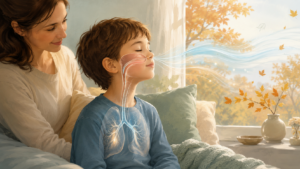
The changes parents notice first tend to be the most visible: a child sleeping with their mouth closed when they previously slept open-mouthed, a reduction in the nighttime snoring or labored breathing that has been a background presence for years, fewer mornings of blocked congestion and low energy.
Changes in asthma symptoms develop more gradually. Fewer episodes triggered by physical activity, which for many children with asthma has been a source of anxiety and restriction. A wider range of activities is becoming accessible without pre-medicating. Less frequent use of the rescue inhaler over the course of a month.
The changes in energy and concentration that parents sometimes report are not incidental. A child who has been chronically underperforming because of disrupted sleep and reduced oxygen delivery carries a cognitive and physical load that is not obviously labeled as breathing-related. When that load lifts, the effects can be surprising in their reach.
When a child’s breathing is normalized and mouth breathing eliminated, the results can feel almost miraculous to the family. Parents are thrilled to see asthma symptoms that once shaped daily life become rare or disappear, and to watch enlarged adenoids stop dominating the child’s sleep, energy, mood, and development.
This is the real promise of Buteyko training for children: not just fewer symptoms, but a different foundation for health. When a child returns to nasal breathing, restores healthier CO2 levels, and learns to breathe in a way that supports the body instead of stressing it, the entire system begins to function differently. For many families, the change is not only physical. It brings relief, confidence, and the joy of seeing their child breathe, sleep, play, and live with a freedom they had almost forgotten was possible.
Book a Private Session
Speak directly with Sasha about your child’s situation and whether the Healthy Child Naturally program is the right fit. → Book Your Private Session
Medical Disclaimer
The services provided by the Buteyko Breathing Center are educational in nature. Sasha Yakovleva is a Buteyko Breathing Normalization Specialist and educator, not a medical doctor. Nothing in this article constitutes medical advice. All decisions about medication, including any reductions in use, should be made in full consultation with your physician. Results vary from person to person.