Breathing for Calm: Why the Left Nostril Can Open the Door to Tranquility
Have you ever paused for a moment and considered your nose?
Not as something ordinary or as just a feature on your face. Not as part of the body that becomes annoying during a cold, but as a doorway.
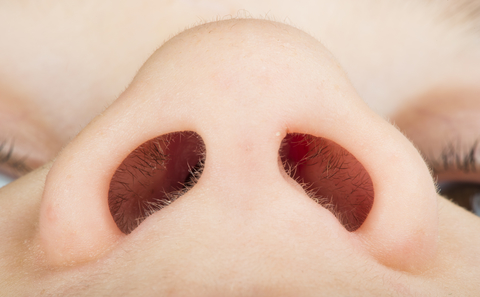
Your nose is not simply two holes for air. It is a living, intelligent, sensitive organ, designed with astonishing precision. And, in a way, your two nostrils are not the same. They are like two small gates into different states of your nervous system, different rhythms of the brain, and different possibilities for healing.
Most of us think that when we breathe through the nose, air enters both nostrils equally. This is not true. During much of the day, one nostril is more open while the other is more closed. Then, after some time, they switch. This is called the nasal cycle.
The Indian culture was aware of this cycle for centuries, but in the Western world, it was first described in the late nineteenth century; however, even now, many people have never heard of it. Inside the nose are structures called turbinates, covered with tissue that can swell and shrink. When one side becomes more open, the other side partially closes. Then the body reverses the pattern. This can happen every 40 minutes or over several hours, depending on the person and the body’s condition.
This is not a mistake or defect; it is how the body does maintenance.
The body gives one side of the nose time to work strongly while the other side rests, moistens, repairs, and protects itself. The nose is not a passive tube but a living, breathing organ that has its own intelligence.
For those of us who practice the Buteyko Method, this is not surprising. We know that the nose is essential. Dr. Buteyko insisted on nasal breathing not because it was a nice wellness habit, but because mouth breathing bypasses a profound part of human physiology.
When we close our mouths and breathe through our noses, we enter a different relationship with the body.
Your nostrils and your nervous system
One of the most fascinating ideas explored in the video above is that the nasal cycle is connected with the autonomic nervous system — the part of the nervous system that regulates heart rate, digestion, blood pressure, stress responses, and recovery.
In simple language, the right nostril is often associated with a more activating, stimulating influence. The left nostril is often associated with a quieter, calming, parasympathetic influence.
This does not mean that one nostril is “good” and the other is “bad.” We need both. We need the ability to act, digest, think, respond, and rest. Health is not about being calm all the time. Health is rhythm, the ability to shift, and balance.
But many modern people are stuck in one direction: tension, alertness, over-effort, over-breathing, over-thinking.
In that condition, the left nostril becomes very interesting.
When we gently close the right nostril and breathe only through the left, we may encourage the body to move toward a more parasympathetic state — slower, softer, less defensive. Research on unilateral nostril breathing is still developing, and results are not always identical from study to study, but several studies connect nostril-specific breathing with changes in cardiovascular function, autonomic balance, and brain activity. (PMC)
This is why left-nostril breathing has been used in yogic traditions for centuries. In yoga, it is often connected with the moon channel, cooling, calming, receiving. But what is beautiful now is that modern physiology is beginning to show us possible mechanisms behind these ancient observations.
The ancients had their language, just like science has its own and sometimes they are pointing to the same mystery.
The nose as a pharmacy
There is another part of this story that is extremely important for Buteyko practitioners: nitric oxide.
The paranasal sinuses produce nitric oxide, a gas with powerful effects in the body. Nitric oxide helps dilate blood vessels, supports blood flow, participates in immune defense, and may help improve oxygen transfer in the lungs. Research published in Nature Medicine reported high nitric oxide production in the human paranasal sinuses. (PubMed)
This means that when you breathe through your nose, you are not simply filtering and warming the air.
You are mixing the incoming air with a substance produced inside your own head — a substance so important that inhaled nitric oxide is used in medical settings for some serious lung and cardiovascular conditions.
And yet, your body produces it naturally.
For free.
Twenty-four hours a day.
But there is one condition: you have to breathe through your nose.
A mouth breather bypasses this system. Air goes straight through the mouth and throat, missing the sinuses, missing the nasal passages, missing much of the natural conditioning and chemical preparation that should happen before air reaches the lungs.
This is one reason I often say that mouth breathing is not just a bad habit. It is a physiological detour.
It is like entering a beautiful temple through the back door and missing the altar completely.
Why this matters in Buteyko practice
In Buteyko work, we often speak about carbon dioxide, oxygen delivery, the Bohr effect, reduced breathing, and the Positive Maximum Pause. These are essential. But the more I teach, the more I see that people also need to develop reverence for the nose.
Not just discipline but reverence!
The nose is the organ of healthy breathing. It naturally slows the breath down. It creates gentle resistance, warms and humidifies the air, protects the lungs, and delivers nitric oxide from the sinuses into the respiratory system. It helps regulate the rhythm of breathing and quietly communicates with the nervous system and the brain.
The mouth is for eating, speaking, kissing, laughing, and singing… and for breathing in emergency-like situations. The nose is for normal, regular breathing.
When a person begins to restore nasal breathing, especially after years of mouth breathing, the change can be dramatic: it improves sleep, reduces or stops anxiety, and normalizes blood pressure. Also the breath becomes more peaceful, and the body begins to remember that it does not need to gasp its way through life.
And sometimes, something very simple — like lying on the right side so the left nostril opens more easily — can help the body settle before sleep.
This is not magic: according to Richard Feynman, the Nobel Prize laureate, it is anatomy, gravity and physiology. But when you experience it directly, it can feel like grace.
A simple practice: left-nostril breathing for calm
Here is a simple practice you can try.
Sit comfortably, or lie down if you are preparing for sleep.
Close your mouth.
Gently close your right nostril with a finger.
Breathe quietly through the left nostril.
Do not pull the air in. Do not make the breath deep. Do not turn this into a performance.
Let the breath be small, slow, and soft. Make sure your mouth is completely closed.
Continue for a few minutes.
The goal is not to “do breathing.” The goal is to allow breathing to become more subtle and peaceful naturally.
If you are very congested, do not force it. If you have a medical condition, severe anxiety, unstable blood pressure, or respiratory distress, be gentle and consult a qualified practitioner or healthcare provider when needed.
In Buteyko practice, force is never the path because you cannot establish peace by war, or balance through violence.
The secret architecture inside your face
What I love about this subject is that it reveals something we forget again and again: the body is not primitive, not stupid, it is not a machine that needs to be bullied into health. The human body is intelligent beyond our comprehension.
Inside the small space of your face, there is an intricate architecture: two nostrils, alternating currents, swelling and shrinking tissues, sinus gases, nerve pathways, brain rhythms, immune protection, and subtle connections with the heart. And all of this is available to us in the most ordinary moment; we just need to be aware of it and learn Buteyko to use it skillfully.
You do not always need a complicated technique, a device, an app, or a new system. Sometimes you only need to close your mouth and notice which nostril is open. Sometimes you only need to breathe gently through the left side and let the body remember the way back to calm.
This is the beauty of the Buteyko breathing approach, which is often called Reduced Breathing, that restores health and improves well-being.