Buteyko Method for Athletes: Tennis, Breathing & Recovery.
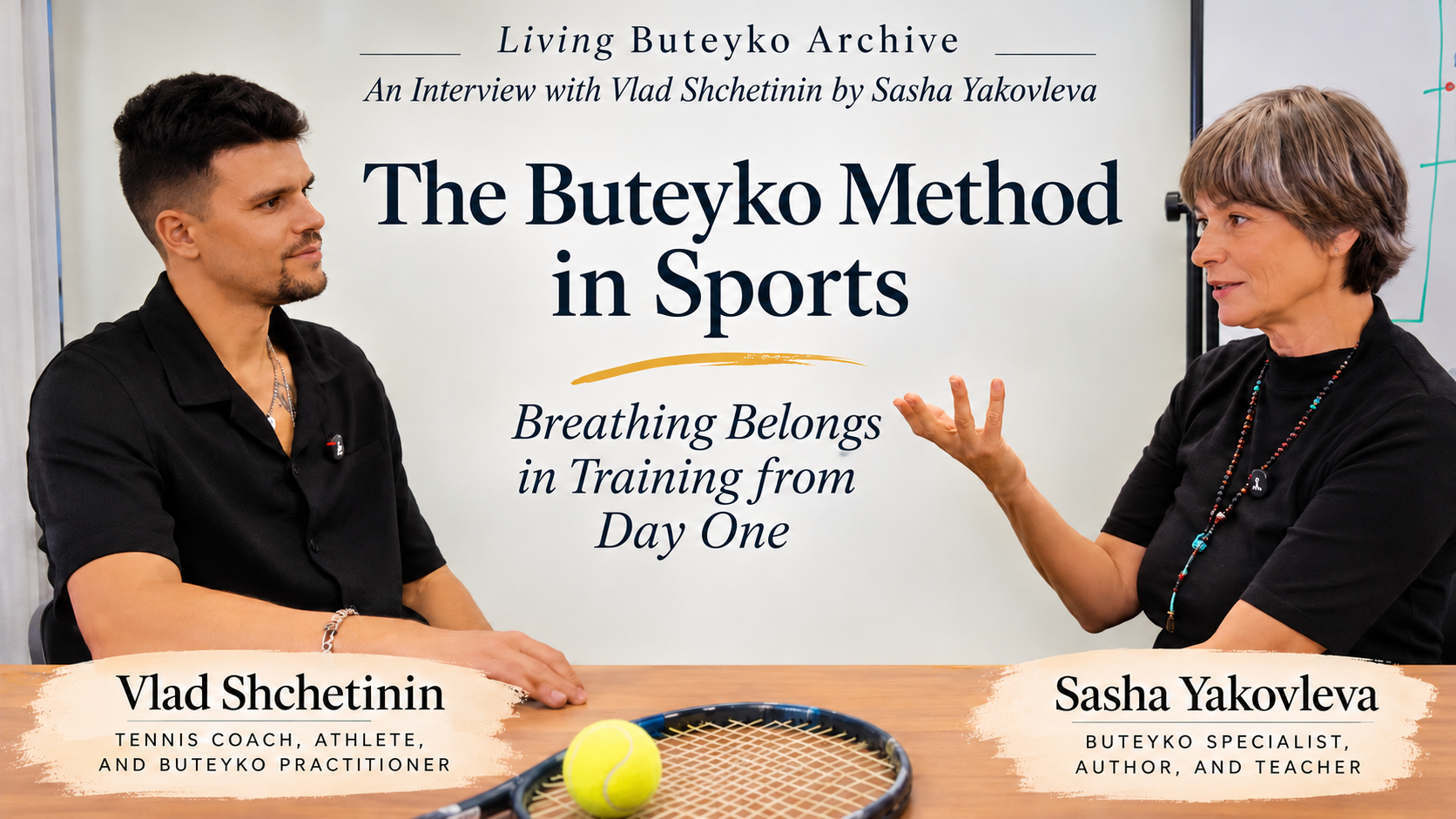
Living Buteyko Archive · An interview with Vlad Shchetinin by Sasha Yakovleva
Vlad Shchetinin, who lives in Moscow, Russia, met Dr. Konstantin Buteyko as a young child struggling with asthma, allergies, and eczema. He remembers the doctor’s presence, learning to breathe “quietly, like a little mouse,” and discovering that changing his breathing changed how he felt.
Years later, those early lessons accompanied him through five-hour training days at an American tennis academy and four years of university tennis. Today, he coaches tennis and other racket sports, teaching his students to pay attention to their breathing alongside their technique.
In this conversation, Vlad shares his memories of learning the Buteyko method and explains why, in his experience, breathing belongs at the heart of physical training—from the first lesson to the final points of a demanding match.
Sasha: Vlad, thank you for coming. Please introduce yourself.
Vlad: Thank you for inviting me. I’m 32, and I’ve been involved in sports since I was a child. I started playing tennis when I was six or seven. Later, padel and pickleball became part of my life too. Now I coach these sports, and I also have an IT project connected with racket sports in America. My whole life has revolved around racket sports.
I also make time for fitness and other physical activities. I go to the gym three times a week, train on my own, and coach others. Sport is an essential part of my life.
Sasha: Your father, Taras Shchetinin, told me that you encountered the Buteyko method when you were a child and quite ill. Do you remember meeting Dr. Buteyko?
Vlad: I don’t remember my exact age. I was probably in first or second grade, around seven or eight. But I clearly remember visiting Konstantin Pavlovich Buteyko at his home. He was lying in bed.
What stayed with me was a feeling: his energy was very bright and strong, and it affected me deeply. That day lives in a separate box in my memory. I think, on some subconscious level, I felt that this method would influence my life. That was when I began learning the method.
Sasha: What do you remember about being ill?
Vlad: I was sick all the time. I had asthma, a cough, very bad allergies, eczema, and rashes.
I remember sitting in kindergarten picking at the crusts on my hands. It was very unpleasant. At that age, I probably didn’t fully understand that I was ill, but I remember my parents constantly trying to treat me—with folk remedies, medication, homeopathy, everything they could. Nothing seemed to help very much.
And I remember someone gave me a machine that made chocolate. Well, I ate too much chocolate, and afterward my skin broke out in a rash.
Sasha: It must have been terribly itchy. Your father described the skin problems as severe.
Vlad: Yes. It was frightening. If I saw something like that now, I would be horrified. I’m very glad I was able to overcome it.
Sasha: How did you learn to change your breathing as such a young child?
Vlad: In a way, the first steps began in kindergarten because I went to a specialized kindergarten where they helped children overcome stuttering. They taught us to speak slowly, without rushing, so I was already beginning to learn some control over my breathing.
Later, at the Buteyko Clinic, they started teaching me the method. They explained things simply, mostly through games. I remember being taught to breathe quietly, like a little mouse.
I remember the room where Ludmila Dmitrievna often worked with me. I also remember my sessions with Dr. Goryunov, the pediatrician.
Even as a small child, I noticed a feeling of lightness when I changed my breathing. I remember that the higher my Control Pause became, the less often I got sick. And, of course, my skin allergies began to clear up.
Sasha: Was there a moment when the Buteyko method became something you wanted for yourself, rather than simply something your parents encouraged you to do?
Vlad: I think that fuller understanding came around fourth or fifth grade, when our whole family went to Crimea to practice. There, I brought my pause up to almost a minute. I felt fantastic. I ran, swam, and had nothing bothering me. I felt as though I was at 120 percent of my normal condition.
Although I was still young, that was when I began thinking: why wouldn’t I keep doing this? And maybe one day I could share it with someone—maybe my girlfriend, maybe my wife, maybe my children. I wanted to bring it into my own circle, into my future family.
Sasha: Your health eventually became strong enough for you to pursue tennis seriously. How did that part of your life develop?
Vlad: I started here in Moscow. Later, I trained at Spartak with Andrey Rublev, who went on to become a star. His mother coached me. To this day, I consider her the best coach I’ve had.
At fourteen, I moved to America to train at a tennis academy. I spent five years there, competed in international tournaments, and finished school at the same time.
The training was intense: about five hours a day, practically every day. Sometimes we had tournaments on weekends too. The Buteyko method helped me keep up with that schedule, build my endurance, and recover.
My health problems had almost completely disappeared. A little irritation remained on my feet because they sweated so much, and I didn’t always have time to change clothes as often as I needed. But I wasn’t having any serious health problems anymore.
After the academy, I went to university and played for a Division I team for another four years, at an even higher level.
Sasha: What happened after university?
Vlad: The COVID pandemic began in the year I was due to graduate, and I returned home to Moscow because I wanted to be closer to my family. Later, I decided to focus more on business, coaching, and training for myself. Professional tennis is very demanding, both physically and financially.
But sport is still an essential part of my life. I hope it stays with me until the very end. The very end.
Sasha: Tennis seems particularly demanding for breathing. You sprint, stop suddenly, then sprint again. Were you able to breathe through your nose, or did you sometimes have to use your mouth?
Vlad: Most of the time, I breathed through my nose while playing. Sometimes I needed to inhale through my nose and exhale through my mouth. Only when the effort became really intense would I also breathe in through my mouth. At the first opportunity, I returned to breathing entirely through my nose.
I admit I used my mouth more when we ran long distances. I don’t like those long runs—I’m more of a sprinter. The academy was in Florida: 30°C heat, very high humidity, and there you were, running, just trying to make it to the end.
In tennis, though, I could use the breaks between points to calm my breathing and get ready to play again.
Sasha: Can you remember a match when you really felt the difference?
Vlad: Very clearly. It was before university, when I was probably near my best form. I was playing against a very strong opponent, and we had long, difficult rallies.
But whenever I went over to my towel and came back, I felt as though I had just walked onto the court. I was ready to run just as much again, even in the heat and humidity.
Sometimes I had only ten or fifteen seconds between points—just enough time to wipe my face with a towel. But because I had practiced the Buteyko method, I could calm my breathing in that short time. As my breathing settled, I calmed down too, and my pulse came down. It sounds like magic, but it’s not. It’s just physiology!
Going to the towel was a ritual my coach had taught me: after a point, walk over, wipe your face, think about what you just did and what you needed to do next. While I was wiping my face, I was already recovering and preparing for the next rally.
We played for an hour and a half or two hours. Afterward, I felt pleasure, not exhaustion. I wasn’t desperate to stop, eat, or drink. It felt as though my body was thanking me for the exercise and for the way I had handled it.
Sasha: So, in those ten or fifteen seconds, while you were simply wiping your face, you were calming your breathing, settling your nervous system, and bringing your pulse down. You could return to the next point feeling ready.
Vlad: Yes. And, really, I wasn’t leaving the method and coming back to it. I was using it throughout the match.
During a difficult rally, my breathing sometimes became heavier than I wanted. But I didn’t let that carry over into the break. I returned to nasal and reduced breathing and calmed it down. That helped me start the next point feeling recovered.
Sasha: Do you remember the opposite experience—what happened when you weren’t managing your breathing as well?
Vlad: Before I understood the method more deeply, I sometimes became dizzy during intense play. I would breathe through my mouth, trying to recover, but instead my vision would become a little dark or cloudy. I needed longer between points.
Someone would say, “Come on, it’s time,” and I’d say, “Just a moment, just a moment, just a moment.” I could still play, but I wasn’t fully focused. It felt as though I had eighty percent of my concentration, and the missing twenty percent was exactly what I needed to win an important point or reach a difficult ball.
You feel that difference in the quality of your work. Instead of playing well, you’re just trying to get through it.
Sasha: What does breathing contribute most to an athlete: endurance, performance, recovery?
Vlad: I would say breathing plays a critical role. It helps with endurance, certainly, but recovery is especially important.
At the beginning of a match, two players may look equally strong. Toward the end, the difference becomes more visible. In tennis, that might be the third or fourth set. In a race, it might be the final five hundred meters.
When the other person is getting tired and struggling to finish, being able to keep your breathing steady, maintain your pace, and stay focused gives you an advantage. Sometimes the difference comes down to a few seconds or one important point.
And recovery isn’t only about the break between points. It’s also about how you feel when you arrive for the next training session. If you haven’t recovered, you start that session already below your best.
You can eat well, get massages, and have an excellent team supporting you. But breathing is part of recovery too. That’s why I pay attention to it away from the court as well as during play.
Sasha: Some athletes achieve brilliant results without paying much attention to breathing. What would you say to them?
Vlad: Of course you can achieve results. We see outstanding athletes with great physical abilities, coaches, and support teams who don’t seem to pay much attention to how they breathe.
But with better breathing, they could go further. You can achieve results without working on your breathing, but the path is harder and the body wears out faster.
When I compare myself with people my age, I notice how they handle physical effort and how I handle it. I can see that the Buteyko techniqes breathing help me stay a step ahead.
Sasha: Today, you teach tennis, padel, and pickleball. So your students are learning both how to play and how to breathe. How do you bring those two things together?
Vlad: From the beginning, I tell students that I can help them improve their endurance and recover between points. I don’t just watch their racket technique. I watch how they breathe too.
I often notice their breathing during the warm-up. We’ve run a little, moved our arms, and someone opens their mouth. I point it out to them, but I don’t force the issue. After all, they came to play tennis, not necessarily to do breathing exercises.
I say, “Look, you don’t have to listen to me. But while I’m collecting the balls, try breathing through your nose. You’ll see the difference.”
The people who try it often become curious. They notice a difference and ask, “Why does that happen?” Then I can explain more and introduce breathing exercises. Their own experience makes them want to learn.
At first, I keep it simple. I want people to enjoy the process and understand what they’re doing. Ideally, every student would learn the Buteyko method, and I work toward that, but I don’t want to force anyone.
Sasha: What do you tell them immediately after a demanding rally?
Vlad: “We’ve finished the point. Now we’re collecting the balls. Breathe through your nose and try to reduce your air intake. You don’t even have to talk. Recover and get ready for the next one.”
Some people aren’t used to reducing their breathing yet. With them, I start simply: close your mouth and breathe through your nose during the break. We take small steps.
And there’s an important distinction: reducing breathing doesn’t mean clamping down on yourself or refusing to breathe. People sometimes misunderstand that. They restrict themselves too much, then need a big breath to compensate. There has to be a balance.
Sasha: So learning to breathe belongs alongside learning how to hold the racket, move, and hit the ball?
Vlad: I think it should be taught from day one. Before someone gets into very demanding training, they should already be learning how to manage their breathing.
You can learn an exercise and perform it well, but if you haven’t learned how to breathe during it, I don’t think you’re using your full potential. And why are you doing sports if you’re not using your full potential? You want to be number one, right? Sports is competitive.
If you want to be the best at what you do, you start with the basics. Breathing is one of them.
And I would want this to become more than a sports ritual. It should become part of life, so the person understands its importance even when they’re away from the court or the gym.
Sasha: Does that apply to people who simply want to exercise and feel well, rather than compete?
Vlad: Yes. It’s not just for athletes. It applies to any physical activity. If you’re doing something physical, pay attention to your breath.
Even during mental work, I find that controlling my breathing helps me organize my thoughts. Sport is a big part of my story, but the method isn’t limited to sport.
Sasha: Looking back — from that little boy visiting Dr. Buteyko to the athlete and coach you are now — do you think the method will stay with you for the rest of your life?
Vlad: Where would it go? I’m already tied to it, and I’m happy about that. I don’t think I would be quite the same person without it. The method changed my life. I know it sounds like a marketing piece, but it’s true. It’s what happened.
Now I’m deepening my knowledge and working toward becoming a fully certified Buteyko specialist. I want to share the method with the people close to me and with people who, like me, have been looking for a way out of illness or that cycle of never fully recovering after training.
And I’m glad I can bring healthy breathing directly into my coaching. My students come to learn a sport, and I also have the opportunity to help them learn something they can use for the rest of their lives.
Sasha: Thank you so much, Vlad, for sharing your memories and your experience.
Vlad: Thank you.