How a New York Times Article Reflects Growing Recognition of the Power of Breathing
It makes me happy to see the power of breathing receiving more and more recognition, including in The New York Times.
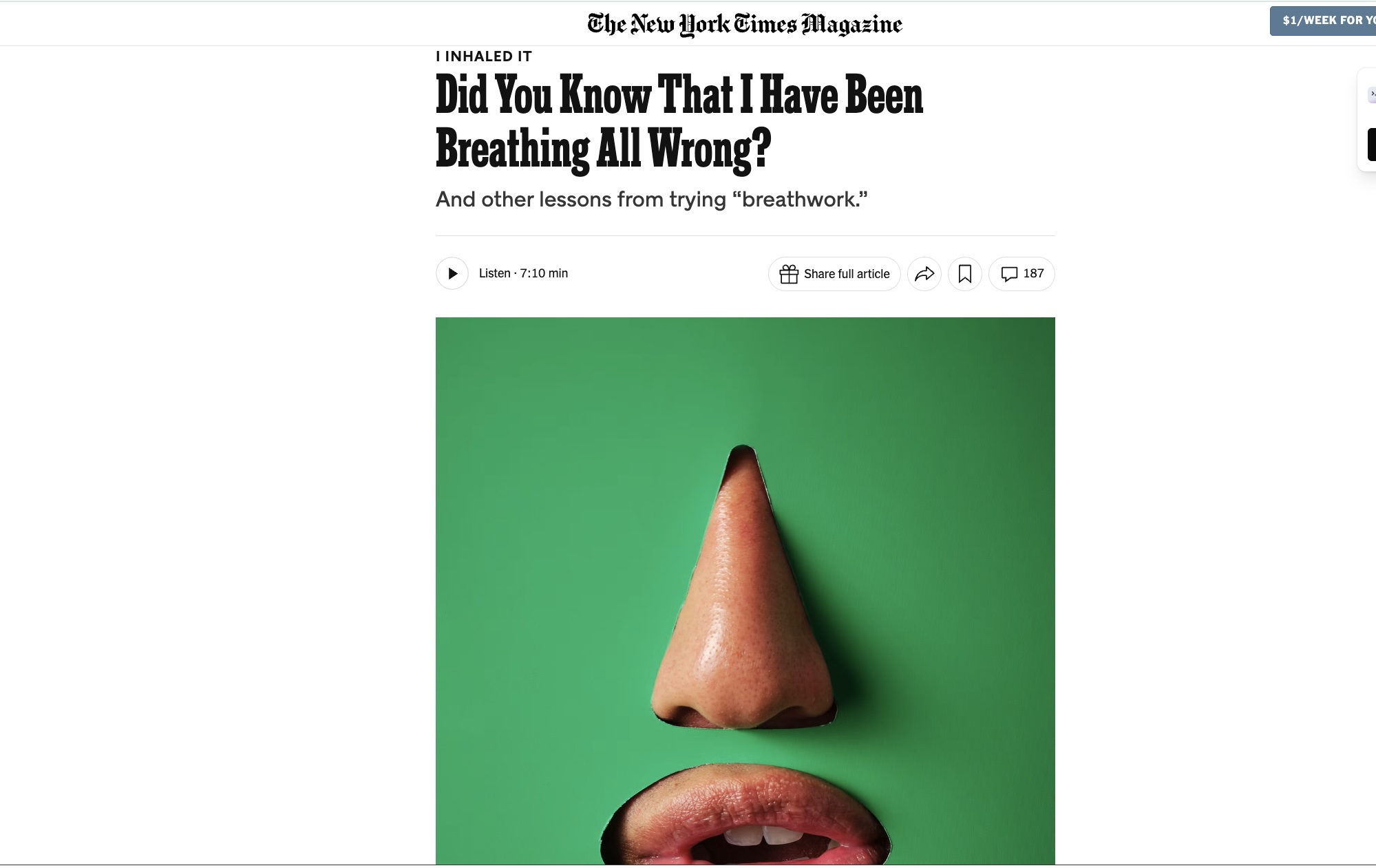
In his humorous, well-written essay, “Did You Know That I Have Been Breathing All Wrong?”, published on October 27, 2026, Sam Anderson describes his journey from dismissing breathwork as a New Age fad to discovering its benefits for himself. He feels less anxious, more present in his body, and less drawn to doomscrolling and stress-eating. Eventually, his wife notices that his nighttime breathing has become surprisingly quiet.
I enjoyed his willingness to explore something he had previously dismissed. Sometimes, experiencing a change in our own bodies opens a door that explanations alone cannot.
Of course, the power of breathing is hardly a new discovery. In India, people have explored the relationship between breath, mind, and health for centuries through yoga and pranayama. In the Soviet Union, Dr. K. P. Buteyko, MD, PhD, and his team of doctors and other health professionals brought scientific investigation and clinical practice to the study of breathing and its role in health. Their work became the foundation of the Buteyko Method.
Now, it seems that a much wider audience in the United States and the Western world is discovering this territory. And that is wonderful! There is no expiration date on discovering something valuable.
For me, Anderson’s article also has a personal connection. Years ago, The New York Times wrote about our work at the Buteyko Breathing Center, highlighting the experience of one of our students with asthma. That article brought an avalanche of inquiries from people with asthma around the world, eager to discover how a natural approach could help with their breathing difficulties.
I also taught the Buteyko Method to James Nestor, whose bestselling book Breath Anderson draws on in his essay. His book introduced many people in the Western world to the power of breathing. Its publication during the COVID pandemic made the subject especially timely: suddenly, people were confronting how profoundly breathing matters—not only to our health, but to life itself.
After nearly twenty years of teaching Buteyko, I welcome this growing attention. Humor can help people become curious about something unfamiliar. But I look forward to the day when major media outlets discuss breathing dysfunction—and the possibility of improving breathing—with the same seriousness they bring to heart dysfunction and improving the function of other organs.
Breathing is happening every moment of our lives. Understanding how it functions, how it becomes disturbed, and how we can improve it deserves more than an occasional amused experiment.
Still, curiosity is a beginning. I am glad to see more people becoming curious about something so essential to their lives.