A conversation between Sasha Yakovleva and Taras Shchetinin about Konstantin Buteyko, the restoration of the Buteyko Clinic, healing children and families, and the future of the Buteyko Method.
The interview took place in Moscow in August 2026, during Sasha’s visit to meet with and record conversations with Dr. Buteyko’s original students.

Sasha:
Taras, it is such a pleasure to see you again. We first met eighteen years ago, when I visited the Buteyko Clinic in Moscow because my husband was severely ill with asthma. That was how I first came to know the Buteyko Method. Since then, I have been teaching the method in the US.
Today I would like to talk about the new Buteyko Center you have opened in Moscow, but I would like to begin with your personal story. How did you first learn about the Buteyko Method?
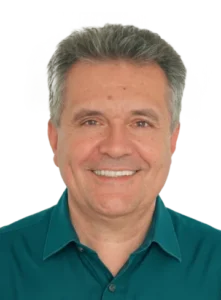
Taras:
It happened in 2002, when I was around thirty years old. I was in business at the time, and our company’s office happened to be located not far from the Buteyko Clinic, although I had no idea it was there.
I had always been very physically active. I went to the gym, ran, played basketball, and played other sports. But at some point, I began to notice a strange pattern: the better my physical condition became, the more often I got sick. At first it was simply colds. Then I began getting bronchitis, which gradually started developing into asthma. Allergies appeared, and my blood pressure began to rise.
Sasha:
You were in the prime of your life, at an age when, especially as an athletic person, you would hardly expect to have serious health problems.
Taras:
Exactly. Yet my health problems kept multiplying.
At home I had an enormous cabinet, almost the size of a refrigerator, that I used as a medicine cabinet. It was packed with all kinds of medications. I had all kinds of syrups – cough syrups, cold remedies, expectorants – and also bronchodilators. But my cough kept getting worse. Sometimes it became so violent that I would literally fall out of bed because my whole body would convulse with coughing. My wife would stand beside me, wanting to help, but she had no idea what she could possibly do. For some reason, the only thing that gave me a little relief was pulling a blanket over myself, curling up in a corner, and trying not to move at all.
I quit smoking, but even that did not change the situation. The attacks kept coming and became more intense, and during them my blood pressure would shoot through the roof. That was how I lived: training—illness; training again—illness again. Eventually it became difficult to tell which there was more of in my life: living or being sick.
Then one day a friend’s father brought me an old, yellowed newspaper, or perhaps it was simply a printed sheet folded into four.
“Here, read this,” he said.
I looked through it. What caught my attention most was that the Buteyko Clinic (it was called a “Center” then) was located very close to me. By then I was already using the internet. There was not much information about Buteyko online at the time, but I managed to find some. I read that the illnesses I had were connected with dysfunctional breathing and could be eliminated by normalizing the way I breathed.
To me, the choice seemed simple: continue depending on that huge cabinet of medications, which were not making me healthier anyway, or try changing the way I breathed. I called the number printed in that old newspaper, and to my surprise, Ludmila Dmitrievna Buteyko herself answered the phone. She listened to me and said, “Come over.”
The center was nearby, so I immediately got into my car and drove there. That was how I met Ludmila Dmitrievna and, later, Konstantin Pavlovich Buteyko and his method. That meeting changed the course of my life.
Sasha:
You arrived knowing very little about the method, and yet you immediately decided to practice it?
Taras:
I already understood that the method had not simply appeared out of nowhere. I knew the Siberian Branch of the Academy of Sciences stood behind it. Konstantin Pavlovich himself also wrote an article in that old newspaper. I sensed that this was serious. That very day, I said to Ludmila Dmitrievna, “If I recover, I will restore your Clinic.”
Sasha:
And did you recover?
Taras:
Well, what do you think?
Sasha:
I know you did. But I am interested in how the recovery actually happened.
Taras:
It took a long time – about two and a half years. My illnesses had been developing for years, and I had taken a great deal of medication, so recovering required serious work. I studied with Ludmila Dmitrievna, and other well-known Buteyko practitioners also helped me.
Almost immediately after I began practicing the Buteyko Method, I was able to stop taking medications. But it took more than two years before I could completely forget about my illnesses. At the same time, it became clear very quickly that I was moving in the right direction.
Sasha:
And was that around the time you brought your son to them?
Taras:
Yes. My son was about seven years old. Almost from birth, he had suffered from severe allergic dermatitis. His skin was covered with a dry red crust, rashes, and cracks, and everything itched terribly. On top of that, he was constantly catching colds. When Ludmila Dmitrievna heard about him, she suggested that I bring him to their home. This was about a year and a half before Konstantin Pavlovich passed away, when he was already not feeling well and rarely received visitors.
That meeting felt almost fantastic to me. At first Ludmila Dmitrievna began working with my son Vlad, making certain energetic passes with her hands. Then she turned to Konstantin Pavlovich and said, “Help me. You see, I can’t manage this.”
Konstantin Pavlovich looked at the child. Vlad later remembered feeling as if he had been enveloped by a big hot cloud, while I saw light coming from Buteyko’s hands.
After that, the situation began to shift, although of course my son still had to make an effort to practice the method. Eventually his Control Pause (or PMP) reached about one minute, and his health improved dramatically. He stopped being sick all the time, and his skin became clear. Occasionally very minor signs of eczema would appear, but he knew how to stop them, and they were no longer a real problem.
Vlad is thirty-two now. He has been involved in sports his entire life. He once wanted to become a professional tennis player, but instead became a professional coach and now teaches tennis and other sports. Whenever he has the opportunity, he also introduces his clients to breathing normalization, which is extremely important in sports.
Sasha:
So, was your son’s recovery what finally convinced you that the method really worked?
Taras:
Yes. And it very strongly determined the direction of my future work. I understood that if a child’s health is already compromised in childhood, that person enters adult life carrying an enormous burden of problems. That is why children’s health became one of the central themes of my work.
Sasha:
Let’s go back to the promise you made to restore the Buteyko Clinic. Why did you say that in the first place?
Taras:
When I first arrived at the Clinic, I already knew that the method was beginning to spread internationally, especially in Australia at that time. Yet the Clinic’s physical condition was completely out of proportion to the importance of what was happening there. Everything in the building was old, many things barely worked, and it was obvious that a major renovation was needed. It was equally obvious that there was no money for it. I wanted to help.
Ludmila Dmitrievna apparently told Konstantin Pavlovich about my offer almost immediately, because soon after I received a phone call saying he wanted to meet me. That was astonishing to me. Who was I to meet this great scientist? Dr. Buteyko was already elderly; he was not feeling well, and he rarely received visitors.
When I entered the room at their home where he was waiting for me, the first thing I noticed was his magnificent posture. He was wearing a traditional Ukrainian embroidered shirt. Konstantin Pavlovich asked whether I knew about the discovery he had made, asked me several other questions, but soon turned to Ludmila Dmitrievna and said:
“He’ll do.”
He’ll do what? I had no idea what he meant then, but now I think those words, in a way, determined my destiny.
Sasha:
Perhaps he immediately recognized in you an organizer – someone capable not only of practicing the method, but of helping to preserve, develop, and expand it.
Taras:
Perhaps. But something else motivated me strongly. I understood that if I recovered, I would suddenly have an enormous amount of time and energy that I had previously spent being sick. And I could direct that time and energy toward doing something useful for other people.
Once my son recovered, it became absolutely clear to me that special attention had to be paid to children.
Sasha:
Later you became the CEO of the Buteyko Clinic.
Taras:
Yes, but not immediately. First we had to put the Clinic itself in order. That was not easy. To carry out a major renovation, we had to suspend the Clinic’s work for a period of time while continuing to support the doctors and other staff.
But we did it. We replaced the utilities, floors, walls, ceilings, and façade, and later we created a new website, buteykomoscow.ru. By that time, I had also helped restore the Novosibirsk center, where the method had originally taken shape.
Sasha:
Where did this strong inner need come from – to make sure that the Buteyko Method remained available to people?
Taras:
I spent a lot of time with Buteyko practitioners who had studied under Konstantin Pavlovich, and some who had worked directly with him. I saw their eyes light up when they realized that the method was beginning to come back to life. They told me how they had once traveled all over the Soviet Union teaching the Buteyko Method, and how sometimes more than a thousand people would attend their lectures and seminars. It seemed wrong to me that nearly all of that had disappeared and that teaching had essentially been reduced to a single Clinic in Moscow.
I also considered – and still consider – it a tremendous strength that the Buteyko Method is not simply a personal theory dreamed up by one man. Behind it stand serious fundamental scientific investigations carried out in Novosibirsk Akademgorodok, within the Academy of Sciences and in major medical institutions. There are scientific papers on hyperventilation syndrome, the effects of hyperventilation on the blood vessels, bronchi and other systems. These are academic publications by scientists and Doctors of Science.
While Konstantin Pavlovich was working within the scientific and healthcare system, he was, metaphorically speaking, accumulating an enormous amount of potential energy – the authority, knowledge, and scientific foundation behind the method. Once he left that system, the potential energy, to use the language of physics, became kinetic: the method began spreading rapidly among people.
What had originally been envisioned was not simply official recognition of the Buteyko Method, but its systematic introduction into the Soviet healthcare system, so that it could be used in clinics as part of regular medical practice. That never fully happened. There were different reasons—resistance, lobbying, and then the Soviet Union itself collapsed.
The Ministry of Health order calling for implementation of the method formally remained in place, but the nationwide rollout was never completed. After the collapse of the Soviet Union, the centralized healthcare structure that was supposed to carry out that work largely disappeared, and no one took responsibility for continuing the implementation. So the method, you might say, went directly to the people.
And that had two sides to it. On the one hand, it became enormously popular. Buteyko was so well known that people could sometimes send letters to Novosibirsk simply addressed “Buteyko,” without a street address or postal code, and the letters would still reach him. On the other hand, everyone started interpreting the method in their own way, adding things, changing things, inventing things. While Konstantin Pavlovich was alive, his authority still preserved a unified approach to the method and the way it was taught. After his death, that central point gradually disappeared, and people increasingly interpreted and developed the method as they saw fit.
Sasha:
And yet the essence of the method itself remains extremely simple.
Taras:
Yes. And that is both its tremendous strength and its problem.
The method is so simple and effective in practice that a person does not need extensive theoretical training in order to evaluate it. You can simply begin practicing it and observe the results in yourself. And results often convince people more powerfully than any advertising or scientific paper.
Sasha:
When you were managing the Buteyko Clinic, you must have encountered an enormous number of recovery stories.
Taras:
Yes. I met people who, according to every prognosis, should no longer have been alive. Today the Buteyko Method is more than seventy years old; at that time it was about fifty. And life brought me together with people who had already lived twenty or thirty years beyond the time they had once been told they had left. Friends and students of Konstantin Pavlovich would come to see me, and everyone had a story. Each person told me what he or she had suffered from and what they had overcome through the method. Some people told me they had had severe cancer, and to me it sounded almost unbelievable. Yet here was the person – alive, standing in front of me, talking to me. And when they spoke about things like gastritis or other gastrointestinal problems, they sometimes talked about them almost as casually as a minor cold: it was there, and then it was gone. At first all of this seemed almost like magic. But I heard these stories again and again. People told them with such sincerity; they showed me their medical records and diagnoses written by doctors. I saw it with my own eyes.
Sasha:
It is interesting that so many people come to the Buteyko Method through their own suffering. Sometimes illness seems to open a door to something a person might never have considered (or believed in) before.
Taras:
Yes. People often find the method when very little hope remains.
And perhaps one reason is that the method seems too simple. A person thinks, “How can this be? I’ve already been through everything with doctors and medications. I’ve spent enormous amounts of money. Professors have examined me, and now you come along and tell me this is just about breathing?” I still hear that all the time. It is precisely the simplicity of the method that creates distrust. And yet that is also where Konstantin Pavlovich’s genius lies. He took an extraordinarily complex mechanism of human recovery and reduced it to an incredibly simple form. Everything truly brilliant is simple!
Sasha:
So the very simplicity of the method becomes an obstacle: people have difficulty believing that something so simple could produce such a powerful result?
Taras:
Absolutely!
Very recently a twenty-three-year-old woman came to see me. She had suffered from severe eczema on her hands and body for more than six years. She was an athlete, a rower, and had reached Candidate for Master of Sport level. She found it difficult to believe that the method could help her. But by the fifth day she came to me with clean, restored skin on her palms. She was shocked, and I was shocked too.
Once a person sees a result like that, there is no need to convince them anymore. They begin practicing the method much more seriously and continue improving their breathing in order to stabilize the result. This young woman had been to many doctors and had undergone serious treatments, including hormonal treatment. And then normalization of her breathing did what the medications had not been able to do for her… and did it very quickly, because at a young age the body has enormous powers of self-restoration.
When she thanked me, I told her, “Don’t thank me. Thank Konstantin Pavlovich.” Because his genius was that he managed to express something fundamental through a very simple principle: exsessive breathing does not bring a person more oxygen; the more a person breathes, the less oxygen the tissues ultimately receive.
Sasha:
So if a person is at least willing to try the method, the results begin to convince them on their own?
Taras:
Everyone has a different mentality, so there is no single formula, but our task is to give people that simple, universal mechanism Konstantin Pavlovich always spoke about. We should not overload students with theories and long explanations, we should help them begin with the most basic things: reduce the depth of breathing, create a mild sensation of air hunger, and relax. These things seem simple, but paradoxically, they are often the hardest things for people to understand and implement.
Sasha:
In addition to your organizational work, do you still teach the method yourself?
Taras:
Of course. I have always tried to learn from different Buteyko practitioners and to accumulate knowledge. And I have always wanted people to receive information about the method from reliable sources.
Sasha:
After you left the Buteyko Clinic, you became particularly involved in children’s health.
Taras:
After the recovery of my son, I wanted other parents to understand that the health of their children is, to a great extent, in their own hands. Later I also became acquainted with Buteyko doctors from Novosibirsk who specialized specifically in children’s health. That gave me the foundation for the work I wanted to do.
Sasha:
If you were sitting today with a group of parents whose children are constantly sick (children suffering from allergies, skin problems, endless colds, and so on) what would you say to them?
Taras:
Today I would answer somewhat differently than I would have twenty years ago. Back then I would have said, “Let’s begin practicing the Buteyko Method immediately and normalize the child’s breathing.” Today I would say, “Begin with yourselves.” Normalize your own breathing, your CO₂ balance, and your relationship to life, because children reflect a great deal of what is happening around them. Today children’s illnesses very often develop on top of an enormous level of stress: the stress of the child and the stress of the parents.
Stress creates tension and hyperventilation. Children watch their parents and imitate their habits, including mouth breathing. When parents themselves begin moving out of a state of chronic hyperventilation, it becomes much easier for them to help their child.
I put it this way: a parent can become a co-creator of a child’s health. Not simply someone who helps improve the child’s health, but a true co-creator of that health.
Today, for example, there is a great deal of discussion about attention deficit hyperactivity disorder. I believe that in many such cases hyperventilation plays a very important role by constantly activating the sympathetic nervous system, and this can be corrected.
That is why I see enormous possibilities for the Buteyko Method not only in medicine—in prevention and rehabilitation—but also in education, psychology and work with children. If parents understand the basics of normalizing breathing and bring them naturally into everyday life, it becomes much easier for the child to adopt those habits as well. I call it basic breathing hygiene.
I recently published a book about this. It brings together my experience as a parent and my many years of working with the Buteyko Method, but specialists were also involved in developing it – well-known pediatricians and Buteyko teachers with more than thirty years of experience. The book was very highly regarded by specialists, including pediatricians, and was recently officially recommended to parents by the Russian Pediatric Respiratory Society. For me, that is a very positive sign.
Sasha:
What is happening with the method today? I know you have created a new Buteyko Center, you are once again bringing together older students of Dr. Buteyko, and there seems to be a new wave of interest in the method. What would you like to accomplish?
Taras:
As always, I want to embrace the un-embraceable. I probably simply do not know how to think small.
When Konstantin Pavlovich died in 2003, I carried the cross at his funeral. I often say that I did not simply carry that cross at the funeral – I have carried that cross with me throughout my life. For me, continuing his work is an enormous and important responsibility. We need to preserve the original work and continue developing it. I do not want merely to popularize the method; I would like to see it genuinely integrated into professional fields: medicine, education and psychology. And it is important to me to move forward not only on the basis of the enormous number of inspiring stories, although those stories are tremendously important, but also through fundamental research, which I intend to support in every way I can.
Sasha:
And at the same time, you continue working directly with people?
Taras:
How could I not? If people find me and come to me, of course I help them. There are not many specialists left in Russia who studied directly under Konstantin Pavlovich and who also possess such a large body of knowledge and experience. That experience needs to be shared. It needs to be passed on.
Sasha:
I love that every time you speak about the Buteyko Method, I can still feel the same tremendous enthusiasm in you. It hasn’t faded with the years; if anything, it seems to have grown even stronger.
Taras:
Because I believe that what we are doing is good; we are on the side of light.
And my greatest source of strength is the people themselves and what they tell me. When a person comes to you sick, begins practicing the method and starts seeing real changes, it is hard to imagine a more powerful form of feedback. Yesterday that person thought of themselves as sick. Today they can see that their condition is changing, that they are getting better. And when you see that person’s eyes, the joy, the gratitude, it gives you tremendous energy. Perhaps there really is a kind of exchange of energy taking place: you give something to a person, and the result they experience gives strength back to you.
That is what gives me the energy to keep moving forward, to continue working, and to continue developing the method.
Sasha:
Wonderful. Thank you.
© 2026 Sasha Yakovleva, Buteyko Breathing Center. All rights reserved.